
A decade of enrollment decline and recent years of increasing student success outcomes have unfolded simultaneously at the University of Toledo — and understanding both trends is essential for what comes next. Since 2016, total enrollment has dropped by more than 6,000 students. At the same time, first-year retention and six-year graduation rates have reached their highest recorded levels. So, what do the numbers really show? We explored over a decade of data from UToledo to find out.
The University of Toledo has seen a remarkable shift in its student body over the past decade. Total enrollment has declined from 20,648 in Fall 2016 to 14,290 in Fall 2025. Spring 2026 headcount fell further to 13,165. However, not all enrollment categories are falling. Fall 2025 saw adult student enrollment increase more than 50% (+72 students), new transfer students rose nearly 2% (+11 students) and graduate enrollment grew 2.2% (+76 students). New programs in neuroscience, radiation therapy and cosmetic science and formulation design each have more than doubled in enrollment since the previous fall semester — suggesting that targeted, market-aligned programs may attract new students to the university.
UToledo’s first-year retention rate reached a new record high in Fall 2025 at 80.4%.
The six-year graduation rate for the Fall 2019 entering cohort was 58.4% — the highest in the institution’s recorded history.
Note: First-year retention rate and six-year graduation rate are standard report periods; the most recent six-year graduation rate is for the Fall 2019 entering cohort.
The share of out-of-state students has remained consistent over the past decade, hovering near 15–16%, with a recent uptick to about 16.3% in 2024. To attract students from neighboring states, starting Fall 2026, UToledo will expand its in-state tuition to new students from Michigan.
Nearly 80% of all undergraduate students commute to class rather than live on campus, a figure that has remained stable from 2015 to 2025. For a university where the vast majority of students may spend only a few hours on campus each day, helping students build social connections and be engaged with campus life is essential for fostering a vibrant campus culture.
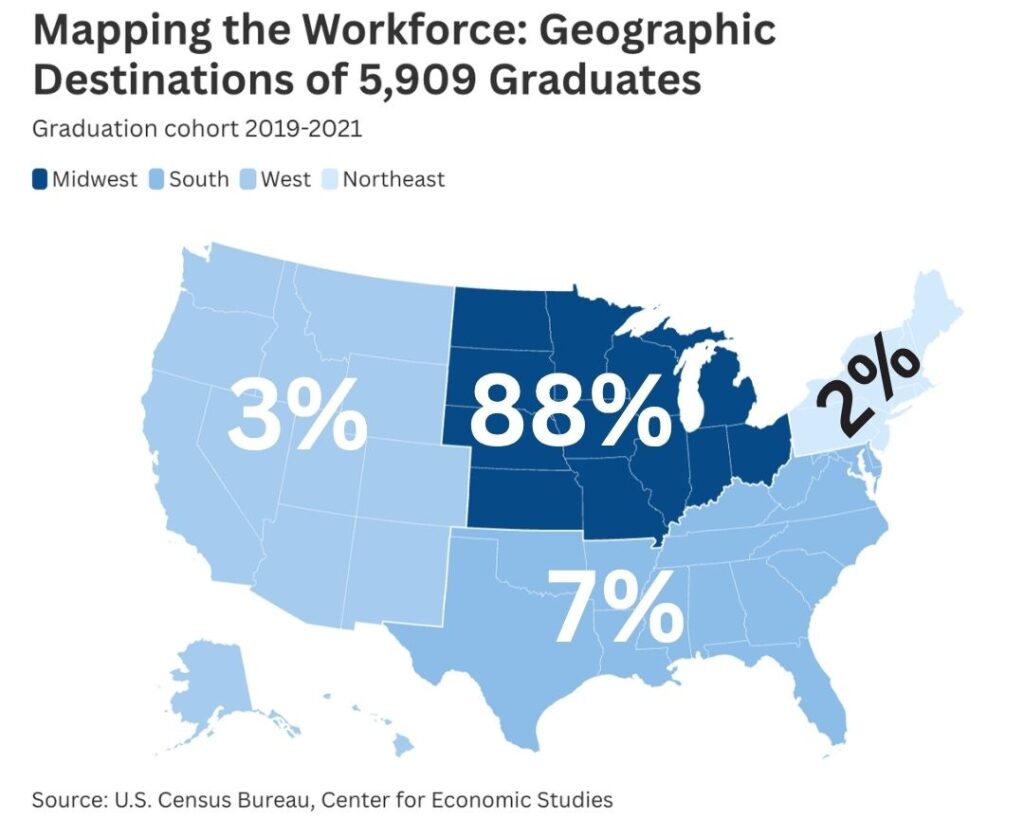
Most UToledo graduates put down roots close to home. Of 5,909 UToledo graduates from the 2019–2021 cohort tracked by the U.S. Census Bureau, 77% remained in Ohio after graduation. Another 11% spread across the Midwest region and 7% headed to the South. This retention rate is a regional economic asset — graduates stay, work and contribute locally. But, it also means UToledo’s reputation is built predominantly within the state. Building national recognition could help attract out-of-state students, who currently represent just 16% of the student body.
In terms of top industry destinations for recent Rocket alumni, Health Care & Social Assistance leads the pack with 1,339 graduates from the 2019–2021 cohort, followed closely by Manufacturing and Professional, Scientific & Technical Services at 984 and 665 graduates, respectively. This alignment between UToledo’s program offerings and graduates in the health professions, business and engineering, specifically reflects sustained investment in academic programs with clear workforce demand and career pathways.
UToledo graduates earn a median starting salary of roughly $52,000 within the first year after receiving a bachelor’s degree, according to the U.S. Census Bureau’s Post-Secondary Employment Outcomes data for the 2019–2021 cohort, placing them in the top five of all Ohio public universities and ahead of several Ohio peer institutions, including The Ohio State University, Bowling Green State University and Kent State University.